The prophets didn't look away from Israel's sins. They named them specifically, publicly, and with grief. We seek to do the same.
What We Are NOT Saying:
- We are NOT saying Israel is uniquely evil among nations
- We are NOT denying that Israel faces real security threats
- We are NOT excusing or minimizing terrorism against Israeli civilians
- We are NOT saying Palestinians (or Hamas) bear no responsibility
- We are NOT calling for Israel's destruction
What we ARE saying:
- Christians should apply consistent biblical standards to all nations
- Love for Jewish people is compatible with accountability for state actions
- The evidence below deserves careful, prayerful consideration
About October 7
The October 7, 2023 attacks on Israeli civilians were evil. Terrorism (the deliberate targeting of civilians) is condemned throughout Scripture. We grieve with Israeli families. We condemn Hamas's actions unequivocally.
However, the existence of terrorism does not provide moral license for unlimited response. The question is not whether Israel can respond, but how. Does the response distinguish between combatants and civilians? Does it seek to minimize harm to the innocent? Is it proportionate?
These are the questions we must ask, the same questions the prophets asked of ancient Israel.
A Word Before You Continue:
What follows is difficult to read. If you feel defensive, angry, or overwhelmed, those reactions are understandable. We encourage you to take your time, verify sources for yourself, and remember that documentation serves truth, not politics.
The Biblical Standard
Before examining evidence, we need to establish the measuring stick. We're not applying a political agenda. We're applying the same standards the prophets used.
"This is what the LORD says: Do what is just and right. Rescue from the hand of the oppressor the one who has been robbed. Do no wrong or violence to the foreigner, the fatherless or the widow, and do not shed innocent blood."
Jeremiah 22:3"Learn to do right; seek justice. Defend the oppressed. Take up the cause of the fatherless; plead the case of the widow."
Isaiah 1:17"He has shown you, O mortal, what is good. And what does the LORD require of you? To act justly and to love mercy and to walk humbly with your God."
Micah 6:8"The soul who sins shall die. The son shall not suffer for the iniquity of the father, nor the father suffer for the iniquity of the son."
Ezekiel 18:20These verses establish clear principles:
- Protect the innocent and vulnerable
- Do not shed innocent blood
- Defend the oppressed
- Do not punish children for their parents' sins
The prophets didn't ask whether Israel's enemies were worse. They held Israel to God's standard. We seek to do the same.
The Humanitarian Crisis in Gaza
The Scale of Destruction
The numbers below come from the United Nations, the World Health Organization, and international humanitarian organizations. Even peer-reviewed medical journals have acknowledged the general reliability of Gaza casualty data.
Civilian Deaths:
- Over 70,000 Palestinians killed since October 2023 (UN OCHA Crisis Tracker)
- The majority are women and children (UNICEF, UN OCHA)
- For comparison: this exceeds the combined civilian death toll of all U.S. military operations since 2001 (Brown University Costs of War Project)
Scale of Bombardment:
- By mid-2025, Israel had dropped over 100,000 tons of explosives on Gaza (Anadolu Agency / Gaza Government Media Office)
- More recent estimates from October 2025 suggest the total may now exceed 200,000 tonnes (Al Jazeera / Palestinian Civil Defence)
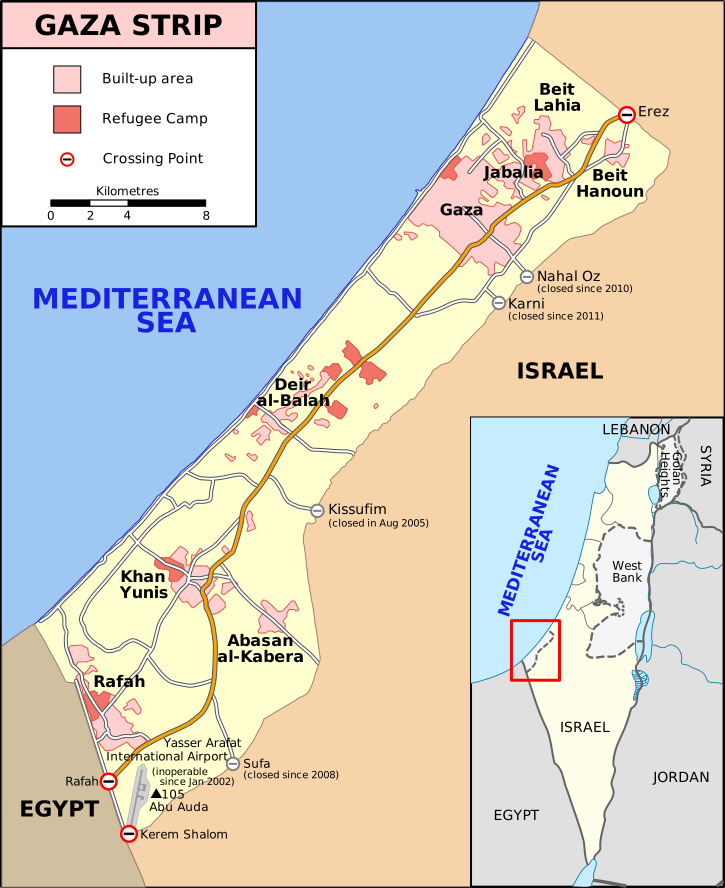
- Gaza is roughly 140 square miles, one of the most densely populated areas on Earth
Hiroshima-sized atomic bombs
The explosive equivalent dropped on Gaza, an area half the size of Hiroshima in 1945
Infrastructure Destruction:
- Over 80% of Gaza's structures damaged or destroyed (123,000+ destroyed, 50,000+ severely/moderately damaged) (UNOSAT satellite analysis, October 2025)
- Entire neighborhoods leveled
- Hospitals, schools, mosques, and churches destroyed (WHO, UNRWA)
- Water and sanitation systems collapsed (UNICEF)
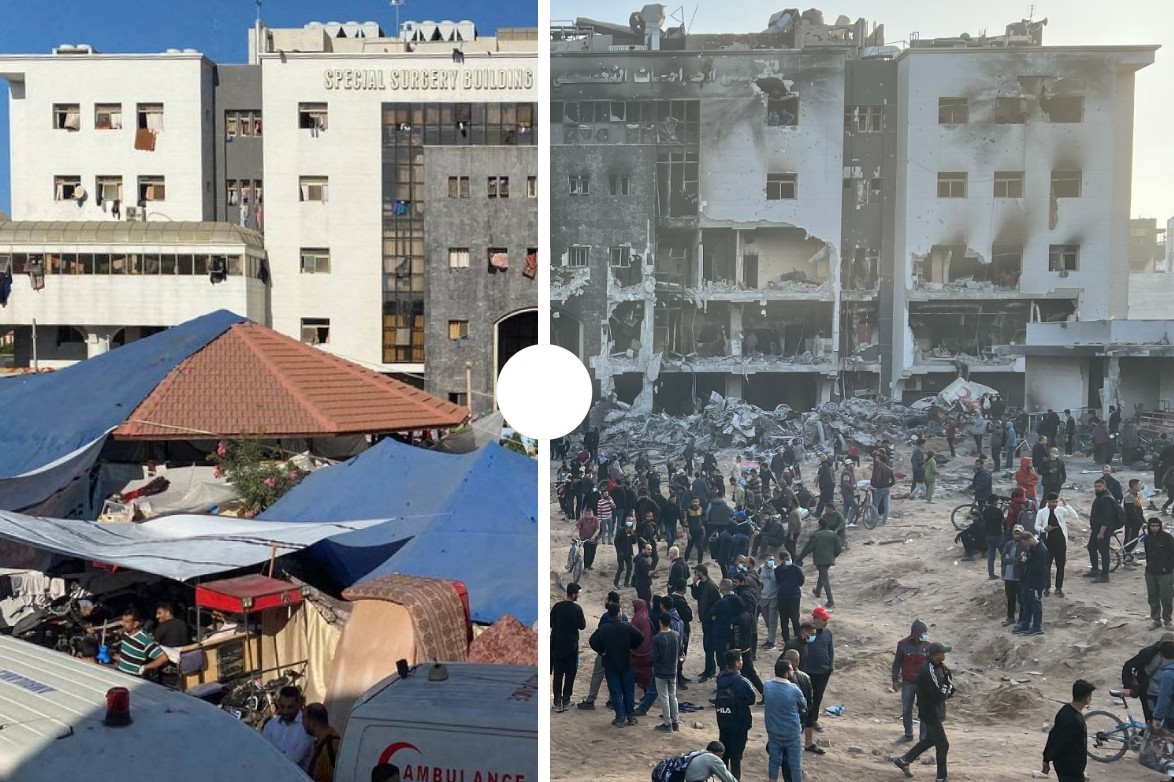
View more before/after satellite images → | UNOSAT damage assessment →
Humanitarian Conditions:
- Famine conditions declared (IPC (Integrated Food Security Phase Classification))
- Medical system non-functional (WHO Emergency Dashboard)
- Children dying of malnutrition and preventable diseases (UNICEF)
- Aid convoys blocked or delayed repeatedly (UN OCHA reports)
Addressing Common Responses
You may be thinking: "Civilians die in every war." Or: "Hamas uses human shields." Or: "Israel warned civilians to leave."
These are fair points that deserve direct response.
"Civilians die in every war" Why the scale matters
This is true. The question is whether the scale and manner of civilian death reflects genuine effort to minimize harm.
- Independent analyses estimate 80% or more of those killed in Gaza are civilians, a ratio of roughly 4:1 civilian-to-combatant (Frontiers in Public Health, Action on Armed Violence)
- For comparison: The U.S.-led coalition in Afghanistan had a civilian casualty rate under 30%. Even the battle for Mosul against ISIS (intense urban warfare) resulted in roughly 10,000 civilian deaths over 9 months, compared to Gaza's 70,000+ over a longer timeframe in a smaller area
- International humanitarian law requires proportionality: the expected civilian harm must not be excessive relative to the military advantage
- Even Israel's closest allies have expressed concern:
- President Biden privately warned Netanyahu that Israel would be "judged harshly" if it didn't minimize civilian deaths (CNN)
- Germany banned weapons shipments to Israel that could be used in Gaza, citing concern for "the continued suffering of the civilian population" (The Intercept)
- France's President Macron said the war must be "without mercy but not without rules" (NPR)
Biblical principle: Yes, there was collateral damage in ancient warfare. But Scripture still holds nations accountable for how they wage war. The prophetic tradition consistently condemns excessive violence and harm to innocents.
The question isn't whether any civilians died, but whether the response reflects the command to "do no wrong or violence to the foreigner, the fatherless, or the widow."
"Hamas uses human shields" A careful examination
What's true: Hamas operates in an urban environment. Gaza is one of the most densely populated places on earth, with 2.3 million people in 140 square miles. There is no "unpopulated" area to which military operations can be confined.
What's contested: The degree to which Hamas deliberately positions military assets near civilians versus the reality that in Gaza, everything is near civilians.
What's undisputed:
- International law holds both sides accountable. If Hamas violates the laws of war, that does not give the opposing force permission to disregard civilian protection
- The presence of a combatant in a building does not make every person in that building a legitimate target
- Destroying an entire apartment block to kill one militant is not proportionate
Biblical principle: Ezekiel 18:20 establishes individual accountability: "The son shall not suffer for the iniquity of the father." Even if Hamas fighters are in a neighborhood, the children in that neighborhood are not guilty of Hamas's sins. Collective punishment violates this principle directly.
Consider: If a criminal took hostages in an American school, would we bomb the school?
"Israel warned civilians to leave" Why this deserves nuance
What's true: Israel has issued evacuation warnings before some operations.
What this ignores:
- Where exactly should 2.3 million people go? Gaza's borders are controlled. Egypt's border is largely closed. There is no "safe zone" that has remained safe.
- Many cannot leave. The elderly, the disabled, hospital patients, those without transportation: evacuation orders assume mobility that many don't have.
- Warnings don't eliminate responsibility. If I tell you to leave your home and then destroy it with your family inside because you couldn't leave in time, I bear responsibility for that death.
- The pattern: Areas declared "safe" have subsequently been bombed. Evacuation routes have been struck. Hospitals have been targeted after civilians sheltered there.
Biblical principle: Consider Rahab in Jericho (Joshua 2, 6). The Israelites made specific provision to protect her and her family. They didn't simply warn her to leave and then destroy everything. Even in conquest, there was specific care for those who should be spared.
What Israeli Sources Report
We don't need to rely solely on Palestinian or international sources. Israeli journalists and military analysts have raised similar concerns:
From Haaretz (Israel's oldest daily newspaper):
"The physical destruction in Gaza exceeds that of Allied bombing in Germany during World War II as a proportion of urban area."
Israeli human rights organizations like B'Tselem and military veterans' group Breaking the Silence have published extensive documentation. (More on their findings below.)
"Rescue those being led away to death; hold back those staggering toward slaughter. If you say, 'But we knew nothing about this,' does not he who weighs the heart perceive it?"
Proverbs 24:11-12This passage warns against claiming ignorance. We cannot say we didn't know. The documentation is available. The images are available. The testimonies are available. The question is what we do with what we know.
Voices From Within Israel
One of the most powerful forms of witness comes from Israelis themselves, people who cannot be dismissed as antisemitic or anti-Israel.
Israeli Human Rights Organizations
B'Tselem (The Israeli Information Center for Human Rights in the Occupied Territories) was founded in 1989 by Israeli academics, lawyers, journalists, and members of Knesset. Their findings include documentation of civilian casualties, reports on conditions in occupied territories, and analysis of military conduct.
Breaking the Silence is an organization of Israeli military veterans who served in the occupied territories. They collect and publish testimonies from soldiers about their experiences.
"We were told that anyone in the area was a target. Age didn't matter. If they were in the zone, they were hostile." Anonymous IDF veteran testimony
These are not external critics. These are Israelis who served their country, who love their country, and who believe that speaking truth is the highest form of patriotism.
Israeli Journalists
Israel has a vibrant free press. Publications like Haaretz, +972 Magazine, and others have published extensive investigative reporting on military conduct, government decisions, and humanitarian conditions.
These journalists face criticism and sometimes threats for their reporting, but they persist because they believe truth matters.
The Significance:
If Israeli Jews (veterans, journalists, human rights workers, academics) are raising these concerns, the conversation cannot be dismissed as "antisemitism" or "Israel-hatred." This is a conversation within the Jewish community, within Israeli society, about whether the nation's actions align with its stated values.
Christians should feel free to join that conversation, not from a posture of superiority, but as fellow seekers of truth and justice.
Palestinian Christian Voices
Many American Christians don't realize that Palestinian Christians exist.
These are believers whose faith traces back to Pentecost, to the very founding of the Church. They worship in some of the world's oldest church buildings. They are our brothers and sisters in Christ.
Their perspective is rarely heard in American evangelical spaces. Here are some of their voices:
Rev. Dr. Munther Isaac

Munther Isaac is a Palestinian Lutheran pastor in Bethlehem and academic dean at Bethlehem Bible College. His Christmas Eve 2023 sermon, delivered from a sanctuary with a nativity scene set among rubble, went viral worldwide.
"We are not seeking to be against anybody. We are seeking justice, only justice. Justice for everybody."
"If you are looking for Jesus, He is under the rubble in Gaza."
The Kairos Palestine Document (2009)
In 2009, Palestinian Christian leaders issued "A Moment of Truth," a theological statement on the situation in the Holy Land. Signatories included Catholic, Orthodox, Lutheran, Anglican, and evangelical leaders.
"The Bible is a story of God siding with the oppressed, the marginalized, and the displaced. We Palestinian Christians find ourselves in those narratives."
Why These Voices Matter:
When you hear "pro-Palestinian," you may picture secular activists or (in the most extreme framing) Hamas sympathizers. But the Palestinian Christian community represents something different: believers who share our faith, who read the same Scriptures, who worship the same Christ, and who are asking the same questions we're asking.
This is not a debate between Christians and non-Christians. This is a conversation within the body of Christ about what faithfulness looks like.
Voices That Demand Our Attention
We've shared voices of Israeli critics who call for accountability. But there are other voices, voices that many American Christians have never heard.
We share these not to suggest all Israelis think this way (many are horrified by these statements, and we've already highlighted Israeli voices calling for accountability). But these are not anonymous internet comments. These are public figures, political leaders, and religious authorities speaking openly.
Why Does This Matter?
Because when we're asked to give "unconditional support," we must ask: support for what, exactly? Support for whose vision of Israel?
Ayelet Shaked, Former Israeli Justice Minister (2015-2019)
In 2014, Shaked shared an article on Facebook that included these statements about Palestinians:
"Who is the enemy? The Palestinian people... They are all enemy combatants, and their blood shall be on all their heads. Now this also includes the mothers of the martyrs, who send them to hell with flowers and kisses. They should go, as should the physical homes in which they raised the snakes. Otherwise, more little snakes will be raised there."
This is not a fringe activist. This is someone who served as Israel's Justice Minister, the official responsible for upholding law and rights.
Source: Washington Post, May 7, 2015, "Israel's new justice minister considers all Palestinians 'the enemy'"
Daniella Weiss, Settlement Leader and Political Figure
Daniella Weiss, 79, is the founder of Nachala, an Israeli settler organization, and former mayor of the Kedumim settlement in the West Bank. CNN has called her "the godmother of the Zionist settler movement." She has been a leading voice in settlement expansion for five decades. In June 2024, Canada imposed sanctions on Weiss "for facilitating, supporting or financially contributing to acts of violence against Palestinian civilians." In May 2025, the United Kingdom followed suit.
At the January 28, 2024 "Conference for Israel's Victory" in Jerusalem, attended by 11 cabinet ministers and 15 coalition members, including National Security Minister Itamar Ben-Gvir and Finance Minister Bezalel Smotrich, Weiss laid out a strategy for Gaza's future:
"There will be no Arabs in the Gaza Strip. They will go to Turkey, to Scotland, to Britain. I don't want to kill them. I want them out of Gaza. And we'll use different methods. One of them is not to give them any humanitarian aid, so the countries of the world will have pity on them and take them."
Note what she is describing: deliberately withholding humanitarian aid, not as an unfortunate side effect of war, but as a calculated "method" to force displacement. This statement was made publicly, at a government-attended conference, in January 2024.
In a March 2024 CNN interview, when reporter Clarissa Ward said her plans "sounded like ethnic cleansing," Weiss responded: "The Arabs want to annihilate the state of Israel so you can call them monsters. You can call them cleansing of Jews. We are not doing to them; they are doing to us."
In an April 2024 BBC interview with Orla Guerin, Weiss explained how this displacement would work: "Normal people don't want to live in hell." When Guerin pointed out that what she was describing sounded like ethnic cleansing, Weiss replied: "You can call it ethnic cleansing, you can call it refugees, whatever you want."
By November 2024, Weiss was reportedly surveying settlement sites inside northern Gaza with IDF soldiers, in contravention of military orders restricting civilian access to the territory.
Sources: January 2024 "Conference for Israel's Victory" documented by +972 Magazine and CBC News. CNN interview: "The grandmother who wants to lead Israelis back to a Gaza without Palestinians," March 20, 2024. BBC interview cited by multiple outlets. Background: Wikipedia.
Rabbi Ronen Shaulov, Religious Leader (July 2025)
Rabbi Ronen Shaulov, an Israeli religious figure with over 150,000 followers on social media, made these statements during a public speech:
"All of Gaza and every child in Gaza should starve to death. I don't have mercy for those who, in a few years, will grow up and won't have mercy for us. Only a stupid fifth column, a hater of Israel has mercy for future terrorists, even though today they are still young and hungry. I hope, may they starve to death, and if anyone has a problem with what I've said, that's their problem."
He invoked the biblical narrative of Amalek, the ancient enemy God commanded Israel to destroy completely, arguing that Israel "mistakenly left a trace" and that "now no trace should remain."
▶ Watch the video on YouTube
(Enable English captions if needed)
This is not a fringe figure shouting on a street corner. Shaulov speaks to large audiences in formal settings. His statements calling for the starvation of children, framed in religious language, represent the very rhetoric that international law defines as incitement to genocide.
Source: Video widely circulated and reported by TRT World, Middle East Eye, Arab News, and cited by journalist Chris Hedges in his Edward Said Memorial Lecture (October 2025).
Moshe Feiglin, Former Knesset Member (May 2025)
Moshe Feiglin served in the Israeli Knesset (parliament) from 2013-2015 as a member of the ruling Likud party and currently leads the Zehut party. In 2008, the UK Home Office banned him from entering Britain, deeming his presence "not conducive to the public good" due to rhetoric likely to incite violence.
In a May 2025 interview on Israeli Channel 14, Feiglin made these statements:
"Every child in Gaza is the enemy. And I'll tell you more than that. Every child, every baby in Gaza is the enemy. The enemy is not Hamas, and it's not Hamas's military wing, like the military prosecutor tells us, that we're not allowed to harm Hamas unless they're part of the military wing."
"We need to occupy Gaza and settle it, and not a single Gazan child will be left there. There is no other victory."
"Every child of this kind to whom you're giving milk now, in 15 years will rape your daughters and slaughter your sons."
This is not a first for Feiglin. In June 2024, Israeli newspaper Haaretz reported that he quoted Adolf Hitler during a Channel 12 interview, stating that Israelis "cannot live in this land if one Islamo-Nazi remains in Gaza." In 2014, he published a plan calling for the conquest and annexation of Gaza and the expulsion of its population.
Source: Widely reported by Middle East Eye, Antiwar.com, TRT World, Anadolu Agency, and documented on Wikipedia.
Public Statements and Social Media
Numerous videos and testimonies have emerged showing:
- Civilians celebrating the destruction of Gaza
- Soldiers posting videos mocking Palestinian suffering
- Public figures calling for total destruction without distinction between combatants and civilians
- Religious leaders framing collective punishment as divinely sanctioned
These have been documented by organizations including +972 Magazine (Israeli publication), Middle East Eye, and various international news outlets. We encourage readers to verify these reports independently.
A Biblical Reflection
Scripture takes the words of leaders seriously. When Israelite kings led the nation into sin, the prophets named them specifically (1 Kings 21, Ahab; 2 Samuel 12, David). Public words from those in authority carry weight.
When religious leaders speak evil, it is especially grievous:
"Her leaders judge for a bribe, her priests teach for a price, and her prophets tell fortunes for money. Yet they look for the LORD's support and say, 'Is not the LORD among us? No disaster will come upon us.'"
Micah 3:11The prophets did not excuse such voices. Neither can we.
Historical Context: Understanding the Nakba
The current crisis didn't begin on October 7, 2023. It has roots stretching back decades.
What Was the Nakba?
The Nakba (Arabic for "catastrophe") refers to the displacement of approximately 750,000 Palestinians during the founding of Israel in 1947-1949.
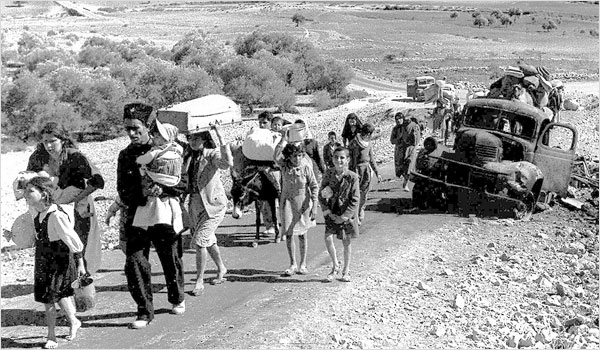
The basic facts:
- Prior to 1947, Palestinians (Muslim and Christian Arabs) comprised roughly 67% of the population
- The UN proposed partitioning the land; Palestinians rejected a plan that gave 56% of territory to a population that owned less than 7% of the land
- During the 1948 war, approximately 750,000 Palestinians fled or were expelled from their homes
- Over 400 Palestinian villages were destroyed
- Israel passed laws preventing refugees from returning and confiscating their property
Is This Disputed?
The broad outlines are not seriously disputed, even by Israeli historians.
Benny Morris, a mainstream Israeli historian at Ben-Gurion University, documented the expulsions in The Birth of the Palestinian Refugee Problem, 1947-1949 (though he argues they were militarily justified). Ilan Pappé, an Israeli historian now at the University of Exeter, characterizes the events as ethnic cleansing in The Ethnic Cleansing of Palestine.
The debate among historians is not whether mass displacement occurred, but how to characterize it and whether it was justified.
Why Does This Matter?
- The conflict didn't start recently. Families have been refugees for 75+ years. Children and grandchildren were born in camps.
- "Just leave" isn't an answer. When people ask why Palestinians don't simply relocate, they're asking people to accept permanent dispossession from land their families lived on for generations.
- Grievance is not the same as terrorism. Understanding why Palestinians feel aggrieved doesn't mean endorsing how some have responded. But dismissing their experience entirely makes peace impossible.
"Do not oppress a foreigner; you yourselves know how it feels to be foreigners, because you were foreigners in Egypt."
Exodus 23:9"When a foreigner resides among you in your land, do not mistreat them. The foreigner residing among you must be treated as your native-born. Love them as yourself, for you were foreigners in Egypt."
Leviticus 19:33-34The Israelites' own experience of displacement was meant to produce compassion, a principle worth considering as we evaluate any situation involving displaced peoples.
Questions for Reflection
We've presented evidence. We've included multiple perspectives. Now we invite you to sit with what you've read.
- The consistency question: If these same actions (this scale of civilian death, this level of destruction) were carried out by another nation, how would we respond? What does consistency require of us?
- The assumption question: Before reading this, what did you assume about people who express concern for Palestinians? Has anything shifted?
- The prophetic question: If Isaiah or Jeremiah or Amos witnessed what's happening in Gaza, what would they say? Would they have words for all parties involved?
- The both/and question: Is it possible to love Jewish people, affirm Israel's right to exist and defend itself, and believe that accountability matters when biblical standards are violated?
- The action question: What does faithful Christian witness look like in this moment? What are you being called to do?
Further Reading
For those who want to investigate further, we recommend these sources, chosen because they span multiple perspectives and have established credibility:
Israeli Sources
- B'Tselem (Israeli human rights organization)
- Breaking the Silence (Israeli veterans' testimonies)
- Haaretz (Israeli newspaper)
International Organizations
- UN OCHA (UN humanitarian coordination)
- Human Rights Watch
- Amnesty International
Palestinian Christian Voices
Books for Deeper Study
- Christ in the Rubble: Faith, the Bible, and the Genocide in Gaza by Munther Isaac (2025): A Palestinian Christian pastor's theological response
- Whose Land? Whose Promise? by Gary M. Burge
- Whose Promised Land? by Colin Chapman
- Blood Brothers by Elias Chacour (Palestinian Christian perspective)
- The Other Side of the Wall by Munther Isaac: Palestinian Christian narrative of lament and hope
A Prayer:
Lord, we confess that these issues are painful and complicated. We confess that we have often believed what was easy rather than what was true. We confess that we have sometimes let political loyalty override biblical faithfulness.
Give us eyes to see what You see. Give us hearts that break for what breaks Yours. Give us courage to speak truth even when it's costly. Give us humility to hold our conclusions loosely where Scripture is unclear.
We pray for Israeli families grieving loved ones lost to terrorism. We pray for Palestinian families grieving loved ones lost to bombs and bullets. We pray for all who work for peace, for all who risk their safety to tell the truth, for all who refuse to let hatred have the final word.
Help us to be faithful witnesses. In Jesus' name, Amen.